Portage
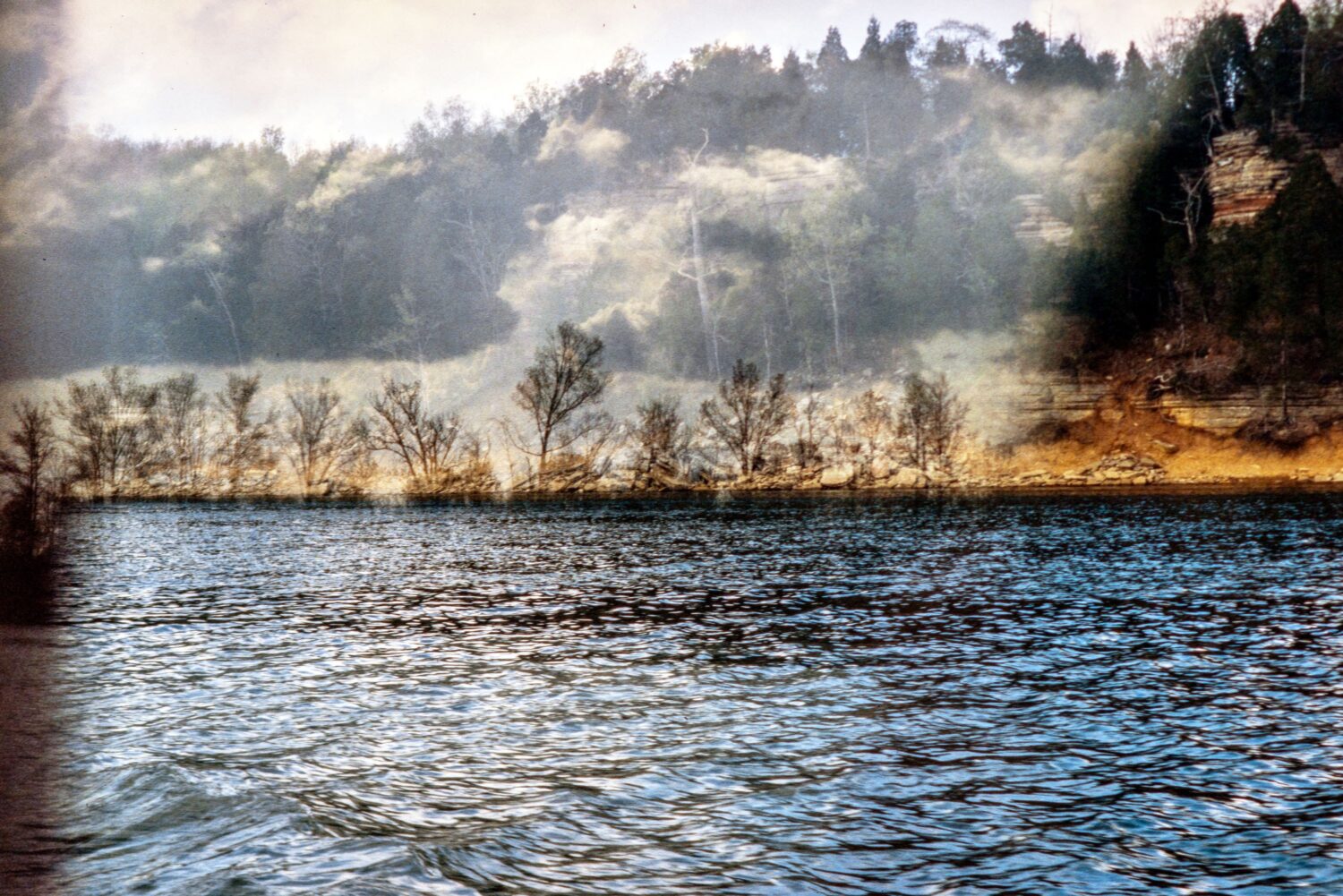
Philip always speaks quietly. The wind over the sandbar does not help. He never moves his lips much, as though not sure he wants to let the words out. On the other hand, he can’t stop talking. Turning my ear this way and that I feel like a fish on a line. Our feet are submerged in a broken hourglass of pock-marked sand. Behind him, the sky has the bald whiteness of a liquid eye. A narrow thatch of winter trees bracelets the horizon. The river reaches up the bank, dispersing in a whitish sizzle. It leaves a wet trace, heavy and dark as pencil lead.
I realize this can’t be right. I can’t hear the wind. I can’t hear anything. I am a visitor. I am, again, imagining things.
***
Our two families of four made fires on that sandbar, grilled hamburgers. The adults drank beer. Philip was my parents’ age, and I was in grade school, so we were a species apart. He and my father were best friends. Our families went boating and camping and watercress-picking. We canoed by moonlight. There were parties where the kids were corralled into a back room to play Monopoly and watch TV, while the adults drank highballs, played music and had conversations about psychology and art. But that was when we were a different formation, before Daddy left to go live with Debora, Karen moved to Nebraska, Wally got Parkinson’s, and the boys grew up and became disinterested.
Philip and I have remained friends. We make art and have coffee, talk and take walks when I’m in town. When I’m not, we have psychic phone calls, “I was just thinking of you, right this minute!” All of those early family years create the launch for a shared sensibility.
The summer before I leave Memphis, he designs the lighting for a dance I choreograph in a small clearing on his land. The clearing is surrounded by trees that are surrounded by pasture that is surrounded by small country roads. The audience arrives by hayride at dusk. They are already happy. They sit on folding chairs with their feet in the grass, slowly fanning themselves with paper programs.
After it gets dark, the dancers emerge from a line of trees. They wear white clothing to stand out against the night. The lighting changes shape, a rectangle catches them across the waist. A square of light creates a room with a grass floor, pulling our interior lives outside. A beam creates a corridor across the grass. The dancers step into it and become moving hieroglyphs, as though signaling, SOS, Go Right, All Clear.
The second part of the dance involves the roof. We have built a large structure that looks like the roof of a small house has been removed and set on the ground. It is at least fifteen feet tall and faces the audience at an angle, so the dancers can disappear behind it, or emerge over the apex.
My father disappeared over our roof when I was three years old. It is my first memory and resides as a five-second movie inside my head. The movie is shot from my perspective standing in the front yard. My father stands on the broad gray canvas of our roof in rural Georgia in late summer. He is shirtless and his pale skin looks orange in the afternoon sun. He climbs up, steps over the apex, and gradually disappears down the back side. I cry out for him to come back. The rest of the memory is only a wild beating inside my chest.
When I ask my parents about this memory, they both claim to have no recollection. So, I am amazed that anyone will take this building of a roof sculpture seriously. But Philip does, and he even gets my father to participate. Though maybe now I realize he was happy to do it, but needed an intermediary, a family buffer. They make some notes, scratch their heads. Philip gets a local farmer to donate wood – he may have given him the impression we were boy scouts. With the help of Philip’s two sons, the roof seems to spring up overnight. I am partly thrilled and partly embarrassed by this richness.
Sometimes I forget that Daddy and Philip were farm boys. I am often impressed by their hovering recumbent skills, thrown off for the excitement of city life. Philip was born in the hills of east Tennessee. The night he drove into Memphis for the first time, he came in Summer Avenue with all its bright street lights and neon. It was the most amazing thing he’d ever seen, and he’d only gotten as far as the rent by the hour bungalow motels. He shares this memory openly and with excitement still in his voice. Daddy hitch-hiked from the family farm to Atlanta, went in store after store until someone gave him a job selling shoes. I pull these details from him, three questions for each fact.
The dancers emerge slowly, standing in a row, shoulder to shoulder. They are walking up the back side of the roof to become visible to the audience. Their heads appear first, gradually, the rest of their bodies. They climb over the apex and down the other side. Move around the roof in various stages of visibility. At the end of the dance the lights go out, but each dancer holds a small pen light like a beacon, an offered hand. I am still here. I haven’t left you.
***
Two months after his death, Philip and I plan Daddy’s memorial service by phone. We have just started to catch our breath.
“Is this Katherine Mitchell?”
“No, Katherine has run off with the milkman and left me to look after her eight children. Who is calling?”
“This is Homer Snopes. But since I’ve moved to Memphis from Mississippi, I’m thinking of changing my name to Dr. Reed, because everyone at the hospital confuses me with Dr. Reed, especially while riding in the elevator.”
I gasp, “And haven’t you always wanted to practice medicine?”
It takes us a while to get to business. I need to hear everything he has to say, his craziness and refusal to live life straight on. I want to listen to his stories and the leather of southern dialect. I miss my father through his voice. He suggests poetry to be read and a bonfire on the sandbar, because my dad loved bonfires. We agree on sandwiches. Gary, the marina owner is providing drinks and ice. Philip has asked Bob to sing and Richard to play the clarinet. And I realize everything will be all right.
***
Philip goes out early to the sandbar with a couple of friends, Billy and Mike, to stack lumber. Miscellaneous odds and ends lean to a point. He wants everyone to be able to see the bonfire from the marina later tonight.
After everyone has made their speeches and read poems and the band is going, I ride over to the sandbar with a small group in Mike’s boat to light the fire. I stay onboard. Daddy’s wife, Debora sits beside me. The fire takes, in a sudden blaze. She is orange in the glow as we pull away. There is a roar from our group at the marina and then silence. Just the burning crackling of the fire which must be 15 feet high and then, just the boat motor, as we skim across the no-wake zone.
Aunt Kay and my sister Karen are crying. After a while, Barbara falls in the water she is so drunk and is pulled out by Mike and Steve who are also drunk. They do their usual how-did-that-happen routine and as usual I am worried about all of them and how they manage not to kill themselves. As the bonfire flames in the distance, Daddy’s oldest friend, Tommie tells one last story. He says Daddy’s nickname used to be Kerosene because he once drank kerosene by accident. Debora says that might explain why once in Italy he complained about the salad dressing being a bit off, only to find out he’d used the lamp oil sitting on the table.
***
We take three boats out McKellar Lake to the mouth of the Mississippi river. The wake sloshes against the side of the boat; the motor, a familial hum. There isn’t much talking, everyone taking in the familiar landscape of barges and grain elevators. We enter the river. The vast blackness of the Mississippi is exhilarating. I remember boating with my father, how he crossed the wake fast to make the boat fly off the water. We’d be momentarily suspended in air before crashing down, a big spray coming over the bow of the boat. Screaming and laughing, my sister and I would hold our butts off our seats, so we wouldn’t bounce, yell at Daddy to cut it out, our stomachs in our mouths.
The sky is becoming a brilliant orange. Our convoy of boats forms a triangle, motors idle. I’ve never seen people on boats sit so still. The funeral home gave us a fancy purple velvet bag, but inside is plastic ziplock, perfect for a man who relied on duct tape and insisted on buying his pants at Kmart. His particles are like some kind of mineral. Debora gives me the bag for a moment. It is surprisingly heavy.
She leans out the wheel house door. His sandy particles fall fast into the water.
***
“Kathy?” Daddy’s musical voice over the phone.
“Hey Daddy.” I’m forty years old and my heart still jumps a little.
“Well, I’m out of olive oil.” He says in a put-out yet cheerful tone.
“What?” I answer, wondering if he is speaking to me or someone in the background.
“I’m out of olive oil– so Debora and I are thinking of coming to St. Louis to shop at that Italian neighborhood.”
I’m thinking that they actually sell olive oil in Memphis, but am not going to argue the point. “When are ya’ll thinking of coming?” I answer instead.
“Well maybe this weekend.” It is Wednesday. “And Mike and Barbara might come with us, but they could stay in a hotel.”
Conversations with my father can feel a little like trying to catch a bus. A bus with an erratic schedule that just so happens to be a crucial transfer to get home. I carry correct change, manage not to run. I’ve asked for something different in every language I know. I’ve had the sense to stop trying and accept the offered code.
***
My father loved motion—cars, boats, travel. He grew up on the family farm sleeping in a room with no heat. He felt lucky to go to school and walked to the one-room schoolhouse, carrying mayonnaise sandwiches for lunch. He was told to “take his nose out of that book!” to feed the pigs or to shell pole beans for supper. After putting himself through school at University of Georgia in Athens, he got a job teaching history at University of Memphis. This led to publications and tenure, marching with Dr. King and protesting the war in Vietnam. Students were known to moan when reading his exam questions. When computers came out, he and Philip took them apart and learned to rebuild them. My mother threw him out of the house when he would not stop sleeping with Debora, and he found his marina house and friends. He literally gave the shirt off his back and people loved him. He flirted with the clerk at the grocery store and knew all waitresses by name. He made everybody laugh. When he got cancer he said he’d lived a charmed life up until that point, and I could tell he felt like he’d finally been caught out. He said the doctor said it would not kill him, but of course it did. But only after he beat the odds and lived longer than projected and worked until 6:30 pm advising students two days before he died.
***
When Daddy and Debora take what turns out to be their last walk out to the boat house where they live, he is so tired, she worries he might collapse and fall off the dock. They’ve been out to their regular Friday lunch. She is paying so much attention to him, that she neglects to watch her own footing and ends up falling in the water. After she pulls herself out, he asks if she is drunk or what, and she says she fell in because she was helping him, and he says clearly he is not the one who needs help.
***
One of the last times I see my father, we drive around Memphis on a Saturday, looking for an open post office. My father drives, a nostalgic comfort. As usual, we have neglected to call ahead or consult the internet, preferring to zig-zag around town. His beard has mostly fallen out, so I can see his face is swollen from the latest round of drugs. His expression is determined, but his freckled hands are gentle on the wheel.
“I don’t know how much longer I’ll live,” he says, matter-of-factly. He quickly follows with the assurance that he feels fine, the side-effects of the latest treatment, tolerable. He tells me that Philip has an extra set of keys to the Manatee and can show me how to operate the sump pump. I am expected not to cry, and I don’t.
One summer night, when I was in grade school, we drove to an ice house to buy a giant cube of ice for a party. It rested on the floorboard of the back seat. I kept turning to look at it, a piece of cloud captured in the car. I worried that it would melt before we got home. My father distracted me by pointing out one of my favorite landmarks—a sparkling coca cola sign that looked like small bulbs were running around its frame. He explained that they were just blinking on and off fast, but I could only see them running.
At the downtown branch of the post office, I climb out of the car, packages in hand. I feel the cold pour through my shirt and realize I’ve left my coat in the car. I start to run. The door swings open, but the cavernous foyer is deserted. My feet clack and echo as I pass the fancy gold scroll work of the little locked windows. I stop. “What’s open?” I ask of the empty space.
***We sit side by side in the sand. Balance on orange flotation devices we took off your boat. We have a cooler with ice and beer. I turn the lid of the cooler up-side down to make a tray. You cut slices of cheese with a pen knife to place on soda crackers. I inherited your red hair, pale skin, and freckles and the tendency to sunburn, so we wear floppy fishing hats from Kmart and long-sleeved shirts. You ask me about school and how the poems are coming along. Ask if I will plant anything new in the garden this year. I tell you all about it and then ask what you are teaching next semester. We drink a second beer. The sun hums at the horizon. Finally, we brush the sand from the back of our legs. I push the boat off the sandbar as you lower the motor. We cruise back home before the cold sets in.